

Small Front Yard Landscaping Layout (A Simple Formula That Works)
Small front yards are harder to design than big ones. I actually think they’re way harder.
In a big yard, you can mess up and nobody really notices. In a small front yard? Every plant decision shows. If something’s too big, too random, or too crowded, you’ll see it every time you pull into your driveway.
And I’ve made those mistakes.
I’ve planted shrubs too close together because they “looked small.”
I’ve mixed too many varieties because they were all on sale.
I’ve tried to squeeze in just one more plant because the bed felt empty.
Two years later? Shrub traffic jam.
Over time, I realized the small front yards that look the best — the ones that feel calm and intentional — all follow the same pattern.
So now I use a simple 4-part formula every time.
It works whether your yard is 10 feet deep or 20.
It works in cold climates.
It works on traditional homes and modern ones.
And once you understand it, you won’t stand in the garden center wondering what to buy anymore.
If your yard feels off but you can’t quite explain why, it’s usually one of the scale issues I talk about in 5 Small Front Yard Landscaping Mistakes That Make Your House Look Smaller. But if you want to build it right from the start, here’s the system.
The items listed are accompanied by affiliate links, meaning I earn a small commission if a purchase is made through my links. This has no impact on the cost to the consumer. I link to products this way whenever possible, and it has no bearing on the products I choose to review or recommend.
Table of Contents Hide
The 4-Part Small Front Yard Layout
Every strong small front yard has four layers:
Anchor plants
Structure shrubs
Repeating mid-layer plants
A defined edge
Skip one of these, and something will feel unfinished — even if you can’t put your finger on why.
1. Anchor Plants (Start Here First)
These are the strongest plants in the bed. They’re the ones your eye lands on first — even if you don’t consciously notice it.
Think of them as bookends.
Without anchors, everything feels like it’s floating. I see this constantly — just a row of mid-sized shrubs sprinkled along the house like someone couldn’t commit.
Where they go:
Corners of the house
Both sides of a walkway
Transition points
In a small yard, two anchors are usually enough.
Height rule:
Try to keep them no taller than about ⅔ the height of your window trim. Once shrubs start creeping up past the windows, the house begins to look smaller instead of framed.
If you’ve ever looked at a house and thought, “Why does it feel swallowed by shrubs?” it’s usually a foundation scale issue. I break that down in detail in The Foundation Planting Mistake I See Everywhere.
Good compact anchor options (Zone 6 friendly):
Dwarf inkberry
Compact boxwood alternatives
Small panicle hydrangeas
Tidy evergreen shrubs
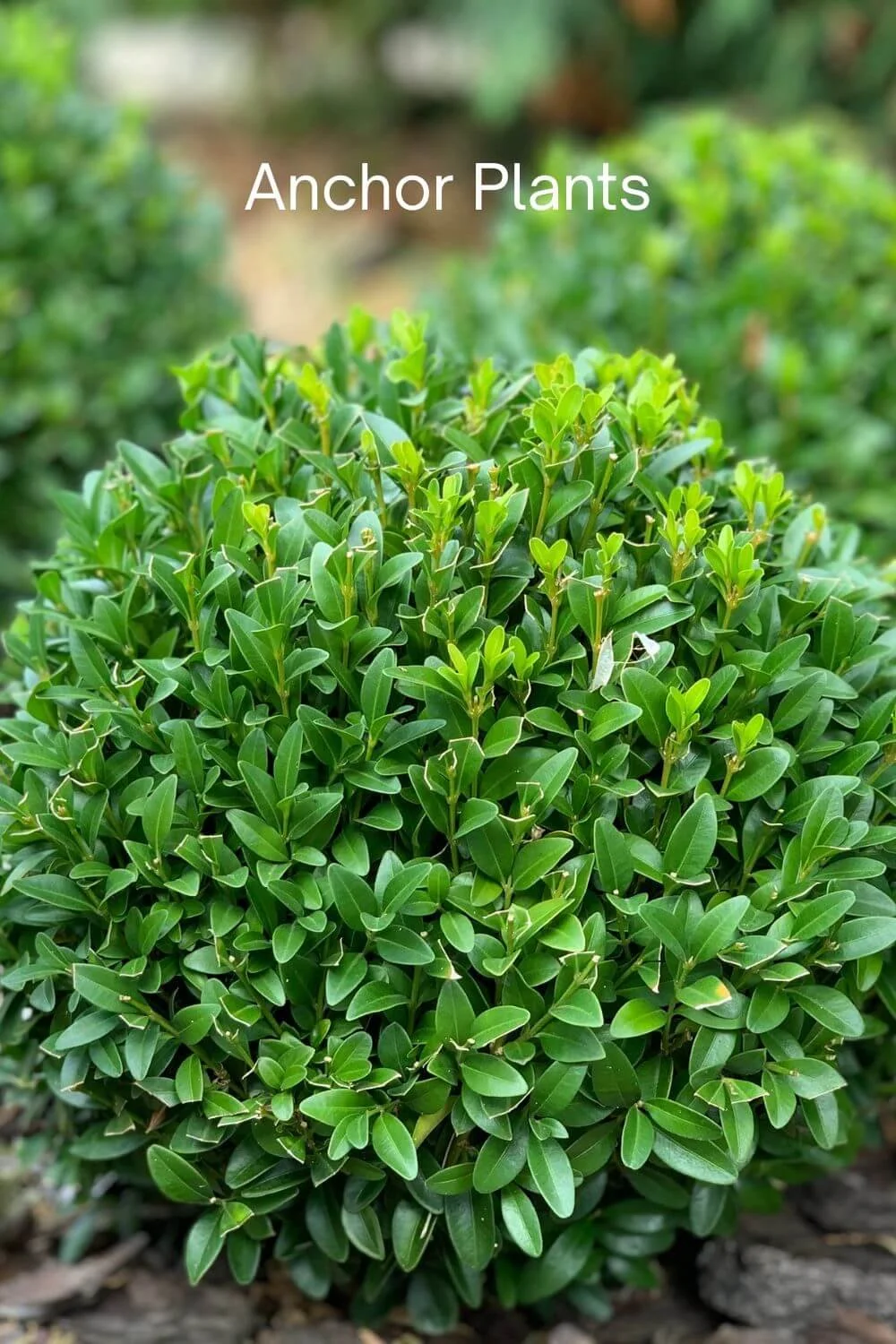
Boxwoods make good anchor plants.
Spacing rule:
Now here’s the part that feels wrong at first.
If a shrub matures 4 feet wide, space it 4 feet apart — measured from the center of each plant.
I know. It will look too far apart. But planting for mature width is what prevents the overgrown hedge look you see in so many neighborhoods.
2. Structure Shrubs (The Backbone)
These sit between your anchors and carry the design across the front of the house.
They aren’t flashy. They’re steady. They’re what keep the yard looking intentional year-round.
The biggest mistake I see here?
Small yards reward restraint. Pick one variety and repeat it. That repetition is what makes the design look intentional instead of like a nursery sampler tray.
If the shrub grows 3 feet wide at maturity, space them 3 feet apart center-to-center. Always plant for the size it will be — not the size it is today.
This one shift alone prevents the overgrown hedge blob that happens in year three.
And I cannot tell you how many times I see that hedge blob.
If you’re gardening in a colder climate like Zone 6, structure matters even more. Winter exposes everything. I break down how to adapt this layout specifically for cold climates in Small Front Yard Landscaping for Zone 6.
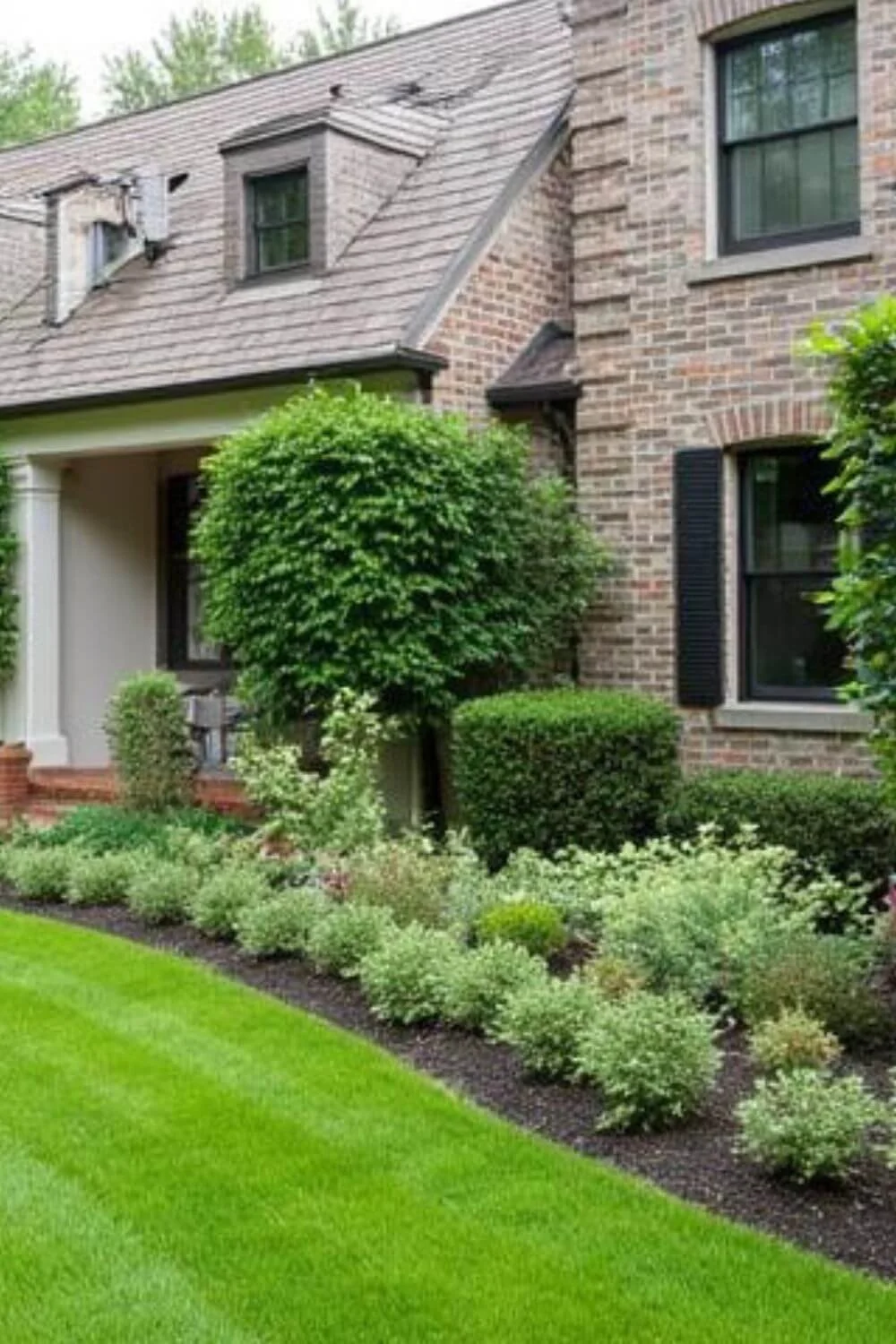
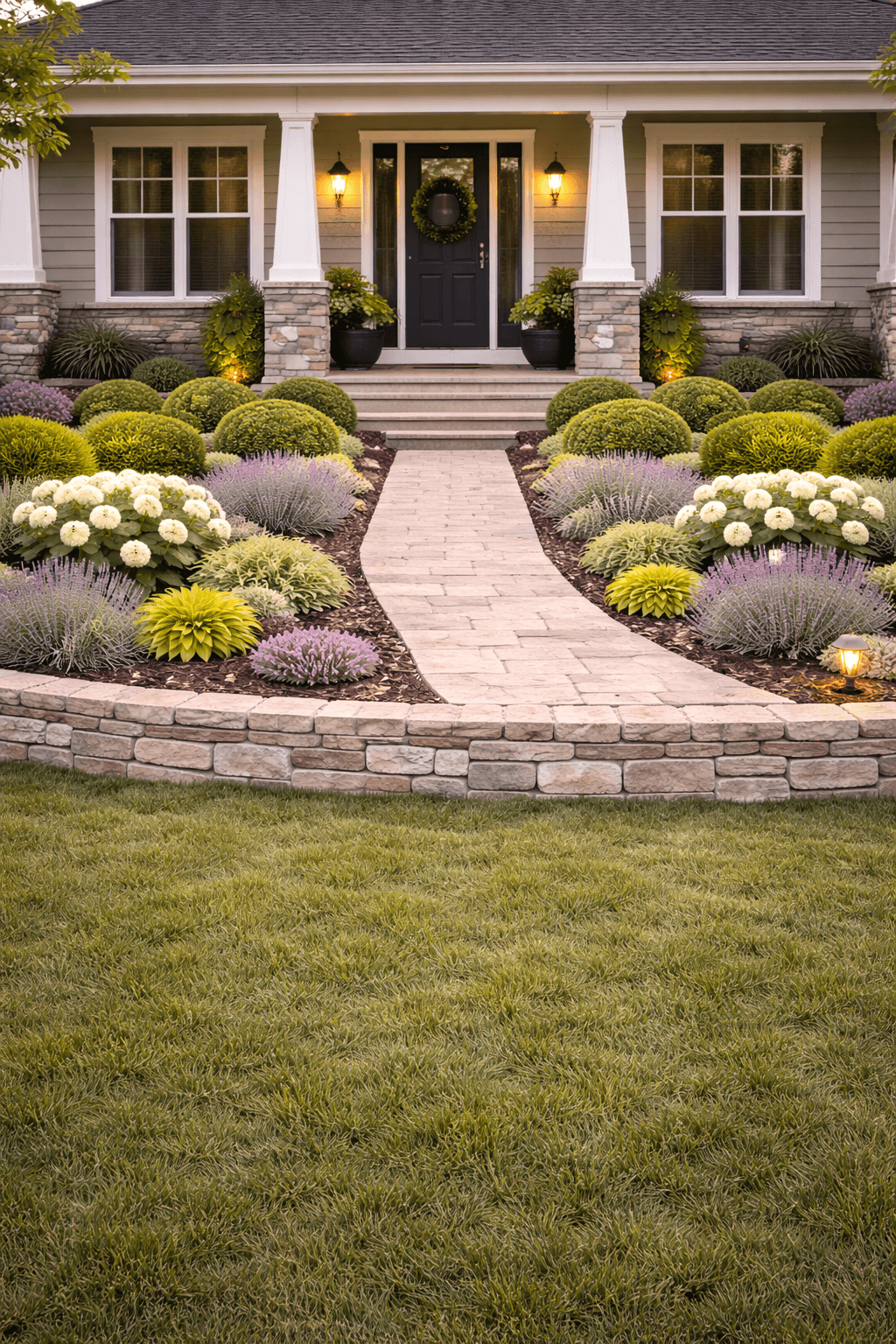
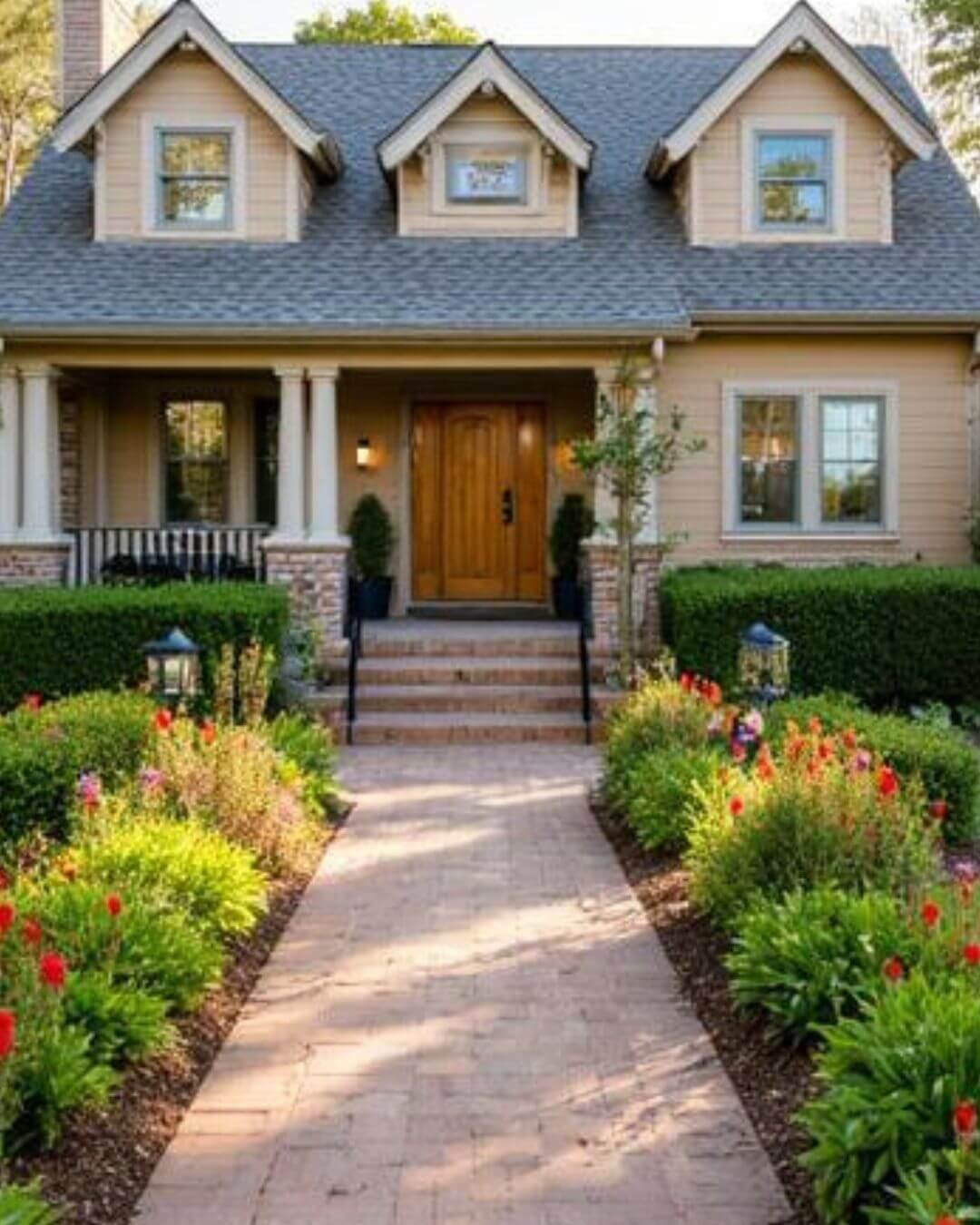
They are using repetition and layering in this landscape.
3. Repeating Mid-Layer (Where the Color Lives)
This is where people tend to overdo it.
You go to the garden center. Everything is blooming. So you grab one of this, one of that, something purple, something tall…
It feels exciting in the cart.
It rarely looks exciting in the yard.
Instead, choose one or two perennials and repeat them.
Repetition is what makes a small yard look intentional instead of chaotic. When you repeat plants, your eyes can relax.
Good small-yard options:
Compact ornamental grasses
Spirea
Dwarf hydrangeas
Catmint
One variety of daylily
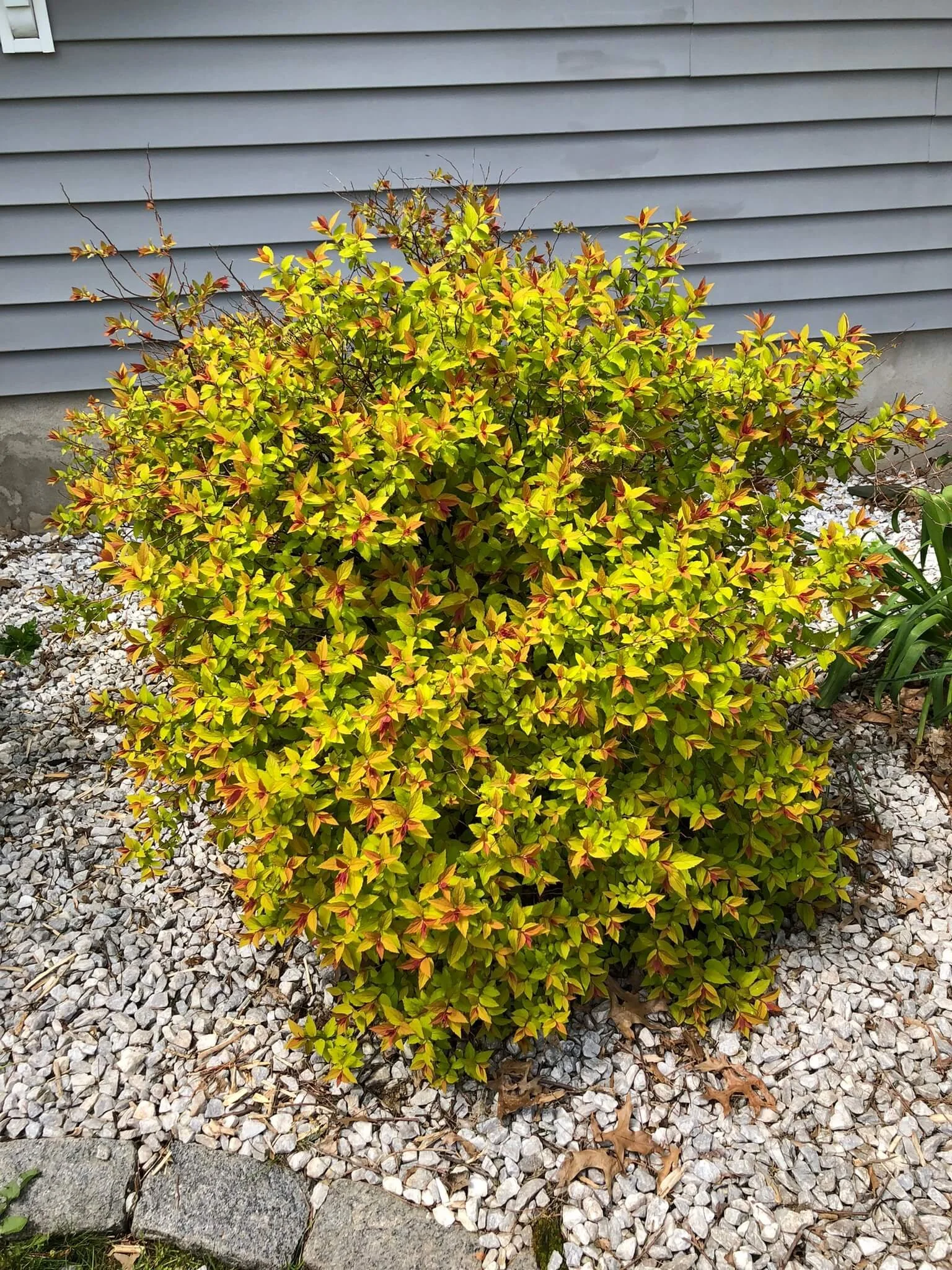
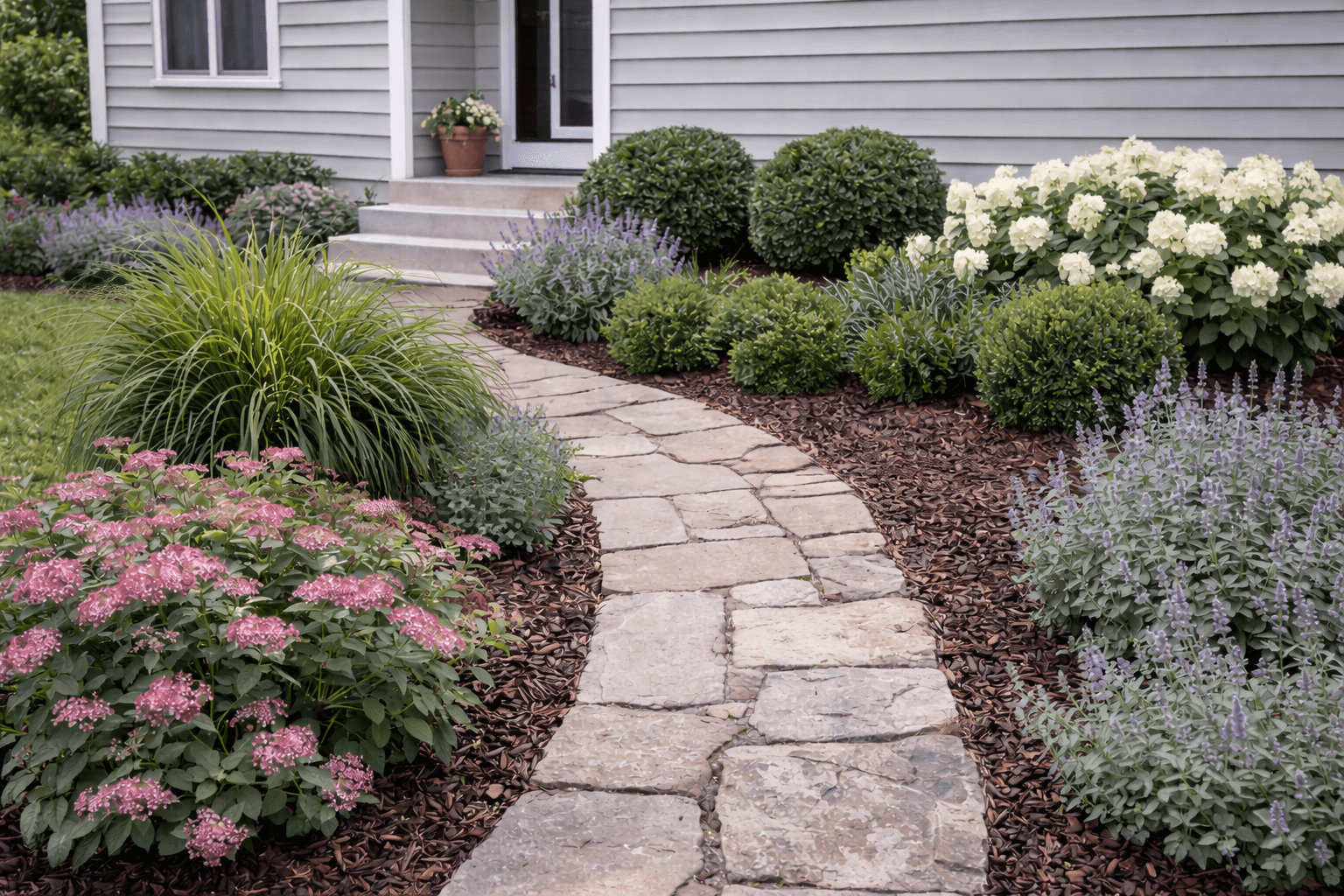
This is Spirea before it blooms. It blooms on new wood and has bright pink flowers when it blooms.
Spacing is usually 18–24 inches for compact perennials — but always check the mature width.
When you repeat plants, the yard feels calmer. More structured. Bigger, even. It’s not about having fewer plants — it’s about having fewer decisions showing.
4. The Defined Edge (The Most Overlooked Step)
You can have beautiful shrubs and still have the bed feel unfinished.
Usually, it’s because there’s no defined edge.
No groundcover.
No border.
No clean mulch line.
The plants end… and it just fades into lawn.
A defined edge creates intention.
That could be:
Low groundcover like sedum or creeping thyme
A crisp mulch line
Steel edging
Stone border
Groundcovers usually need 8–12 inches of spacing, depending on spread.
When I walk past houses with beautiful shrubs but no defined edge, it always feels unfinished — like they stopped just before the final detail that pulls everything together.
That clean edge is what makes the layout look polished instead of planted.
If you need ideas that are realistic and not fussy, I share practical examples in Landscape Border Ideas That Beginners Will Love.
That finishing line makes a bigger difference than most people realize.
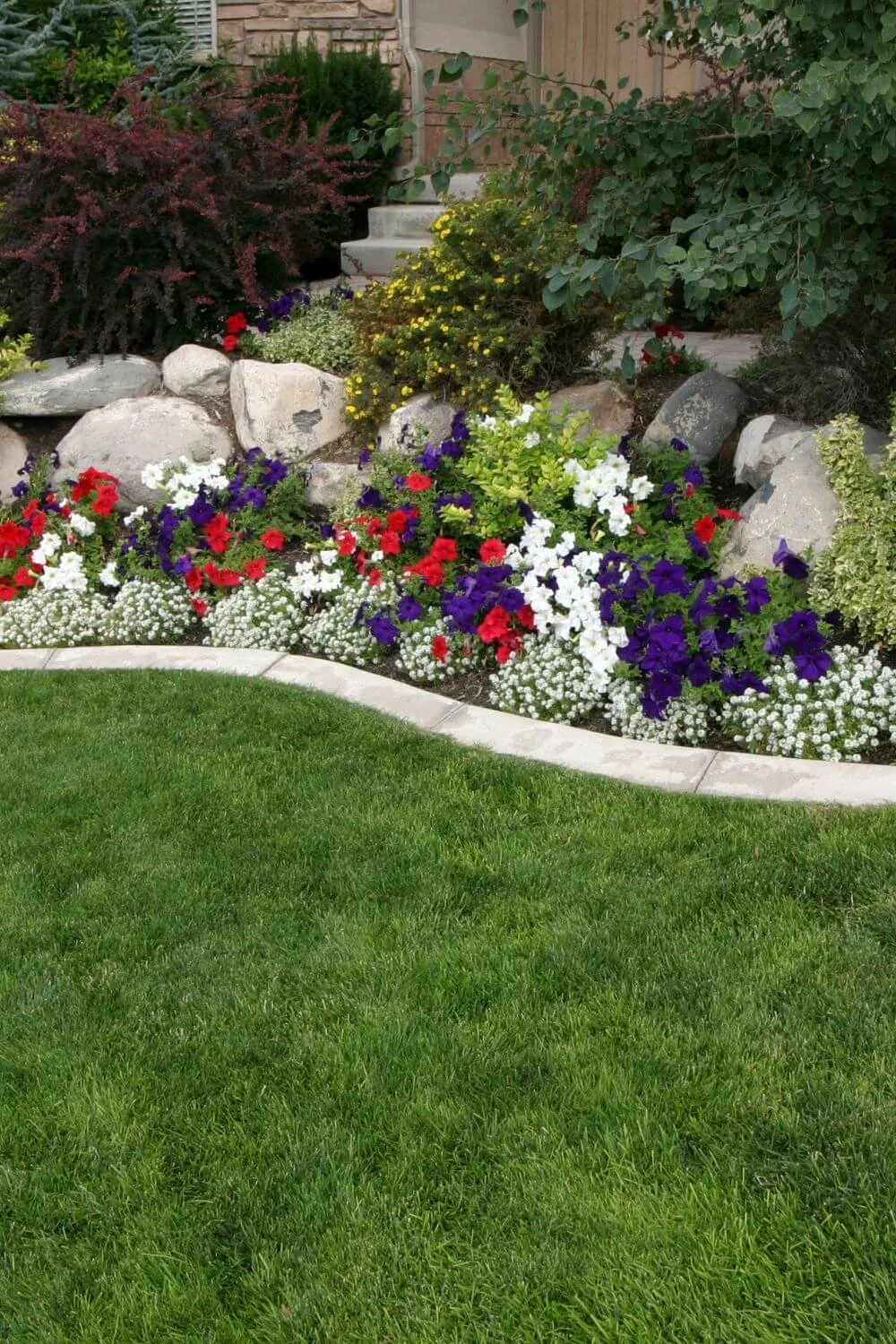
Pavers/stones can help to define your edge and make it look more finished.
A Real Example: 12-Foot-Wide Small Front Yard
Let’s make this practical.
If you have a 12-foot-wide planting area, I would typically do:
2 anchor shrubs (one at each end)
3 repeating structure shrubs
A group of mid-layer plants repeated
One continuous groundcover edge
That’s it.
Not 14 plant varieties.
Not a “fun mix.”
Just spacing and repetition. The houses that look the best in my neighborhood all follow this kind of rhythm — whether the homeowners realize it or not.
And if you’re considering removing grass entirely in a small front yard, the same structure still applies — just without turf. I walk through that approach in No-Grass Small Front Yard Landscaping.

Common Small Front Yard Layout Mistakes
If something feels off in your front yard, it’s usually one of these:
Shrubs planted too close together
Ignoring mature size
Too many plant varieties
No clear anchors
No defined edge
Small spaces are unforgiving. Once something outgrows its spot, you notice it every time you pull in the driveway.
And once you see it, you can’t unsee it.
Before You Plant Anything
Take ten minutes and:
Measure the total width
Measure the depth from the house
Check window height
Note sun exposure
Look up mature width for every plant
Most small front yard problems aren’t plant problems.
They’re spacing problems.
And once something outgrows its space, you’ll see it every single day.
The Bottom Line
You don’t need more plants — you need a system.
Anchor.
Structure.
Repeat.
Edge.
That’s it.
When you follow this layout, your small front yard won’t feel crowded or random. It will feel intentional.
And that quiet, pulled-together look? That’s what actually boosts curb appeal.
If you’re just getting started with your front yard as a whole, you can also explore the broader guide here:
Front Yard Landscaping Ideas for Home Gardens.



Spring porch planter recipes you can copy. Discover simple flower combinations for early and late spring that make your front porch feel intentional and elevated.